Field Placement Program
Overview
The Field Placement Program provides students an opportunity to perform legal work under the supervision of an attorney at approved offices and nonprofit organizations.
Students enrolled in the Field Placement Program work a specified number of hours per week under the supervision of an attorney, complete a goals memorandum, maintain weekly journals of their experience, attend required class sessions, complete online work and write a final reflective paper.
Past field placements include: the United Nations, JAG Corps, Colorado Attorney General’s Office, Kansas Attorney General’s Office, EPA, Department of Education Office of Civil Rights, ACLU of Kansas, Spencer Museum of Art, the Kansas Department of Revenue and many more.
Field Placement Program Resources
Field Placement Program Application
To apply, submit a completed Field Placement Application form and supporting documentation by email to Glenn Jewell at gjewell@ku.edu and to Janette Roundy at janetteroundy@ku.edu. It will be reviewed and you will be notified whether you have been accepted into the program.
Students must attend both a mandatory orientation class and a mandatory Professionalism in Practice class. Students who do not attend will not receive credit through the Field Placement Program. Students should plan the start dates of their field placement accordingly.
Field Placement Application form and supporting documentation can be found on Canvas.
Admission to the Field Placement Program
In order to enroll in the Field Placement Program and receive credit for a field placement, you must:
- Have completed two semesters of law school;
- Be in good academic standing;
- Have a firm field placement offer that meets the requirements below; and
- Apply and be accepted into the Field Placement Program.
Field Placement Ideas
If you are not sure where you want to work or want ideas, make an appointment with Professor Jewell at gjewell@ku.edu.
Field Placement Program Limits
A student may earn a maximum of six hours of credit toward graduation in Law 894 (the general field placement class). All field placement hours count toward the 16-credit hour limit on field placement and clinic credit hours that may be applied to graduation.
Field Placement Application Process
The Field Placement application is available in the “Apply for the Field Placement Program” accordion. Submit a hard copy of this completed form and supporting documentation to Janette Roundy at janetteroundy@ku.edu.
Field Placement Program Enrollment
Once your application has been reviewed, if admitted, you will be notified of your admission into the program and sent an enrollment code that will enable you to enroll in LAW 894 Field Placement Program.
(If you are enrolling for summer, enroll for the first summer session, rather than the second summer session, regardless of which part of the summer you will be working.)
Field Placement Program Application Deadlines
- Fall Semester: The Friday before the first week of classes
- Spring Semester: The Friday before the first week of classes
- Summer Semester: The Friday before graduation
Field Placement Job Requirements
- The field placement must be with a government office or a nonprofit. Credit is never given for work at a for-profit entity.
- You may not have previously worked in that position for pay.
- You may not be paid for your field placement work. (This excludes some general stipends.)
- You must be directly supervised by an attorney.
- Your work must be primarily legal work.
Field Placement Hour Requirement
You are required to work 42.5 hours for each hour of credit earned.
Field Placement Coursework Requirements
In addition to working at your field placement, students are required to:
- Complete online coursework;
- Attend scheduled classes;
- Meet with Professor Jewell at least once during the semester, either in person or by phone; and
- Submit a goals memo, keep a weekly reflection journal, and submit a final reflective paper.
Field Placement Orientation
All field placement students are required to attend Field Placement Orientation in person prior to the beginning of their field placements.
Glenn Jewell is the director of bar preparation and the director of the Field Placement Program, including the 6th Semester in D.C. Program, at KU Law. He also teaches the Extended Bar Preparation and Employment Law classes at the law school. Prior to joining the law school, Jewell was in private practice on Saipan, Commonwealth of the Northern Mariana Islands, focusing primarily on employment law, civil litigation, and general corporate matters. He also practiced employment law in Kansas City for four years.
Student Testimonial: Connecting undergraduate background with legal goals.
Maria Almirudis, L'27
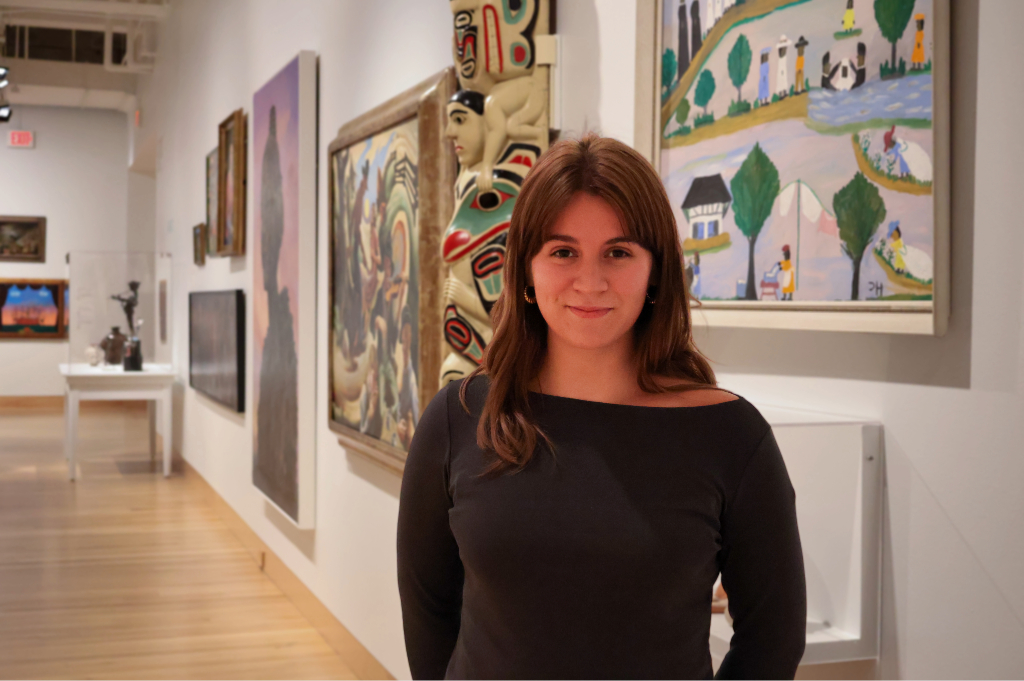
Maria Almirudis spends much of her time outside of class at the Spencer Museum of Art. Unlike most of its visitors, the second-year law student isn't there to view the museum's vast collection of art but instead to review contracts, create loan addenda and write legal memoranda.
Almirudis was a legal intern for KU’s Office of the General Counsel through the University of Kansas School of Law's Field Placement Program. She chose to work with one of their clients, the Spencer Museum of Art, because of her background in art history and desire to reconnect with the field while in law school.
“I believe the Field Placement Program is an extremely rewarding experience,” Almirudis said. “You gain valuable, hands-on experience working with attorneys in a relatively low-stakes environment.”
Almirudis shared her experience with the Field Placement Program for a Q&A.
Why did you choose to do a field placement while in law school, and why did you choose this one specifically?
I wanted the chance to experience different types of legal work. As a first-generation law student, I honestly do not know what I want to practice or what the breadth of legal practice looks like. Over the summer, I clerked for a federal judge, which allowed me to learn about litigation. Through my internship with the Spencer Art Museum, I have had the opportunity to experience transactional law.
I chose the legal internship with KU’s Office of the General Counsel and the Spencer Museum of Art because I was a history of art minor in undergrad at KU. I loved my time in the history of art department and was looking for a way to reconnect with a field I enjoyed.
What type of work did you do through your field placement, and what was your official title?
In this field placement, I do a variety of things. I am responsible for meeting with museum staff, reviewing contracts, creating loan addenda and writing legal memoranda. The bulk of my work involves revising contracts and balancing the interests of the museum with the protection of the university.
My official title is legal extern. I am technically the legal intern for KU’s Office of the General Counsel, but I work directly with their client, the Spencer Art Museum. Ultimately, I work under the supervision of the General Counsel, advising the Spencer Art Museum with their approval.
Read more about Maria's experience.
Questions?
Glenn Jewell
Professor of Practice
Director, Field Placement Program
Director of Bar Preparation
gjewell@ku.edu